India's first AI Fest Concludes at Chandigarh University; Launches AI Ethics Training Program with Target to Train 1.5 Lakh Youth by 2030
-
‘Campus Tank’ Grand Finale Culminates with Announcement of Top 10 Startups Securing Access to $6 Million Funding Pool on Final Day of ‘AI Fest – 2026’ at Chandigarh University
-
‘Don’t Scale Up your Business Before Making a Winning Product’, says Nirmit Parikh, Group CEO – Apna: ‘AI Fest – 2026’ at Chandigarh University
Marking a defining milestone in the country’s entrepreneurial journey, the Grand Finale of ‘Campus Tank’ – India’s first university-led startup launchpad for young innovators was held at Chandigarh University on the third and concluding day of India’s first ‘AI Fest – 2026’ on the sidelines of the ‘AI Impact Summit’ where the announcement of top 10 startups was made who secured access to a $6 million funding pool. The Campus Tank is a first-of-its-kind initiative, led by Chandigarh University in collaboration with Apna – an Indian unicorn and leading professional job networking platform and Venture Catalysts, one of India’s leading startup incubators, culminated in a high-stakes Demo Day bringing together some of the country’s most promising young innovators on a single platform.
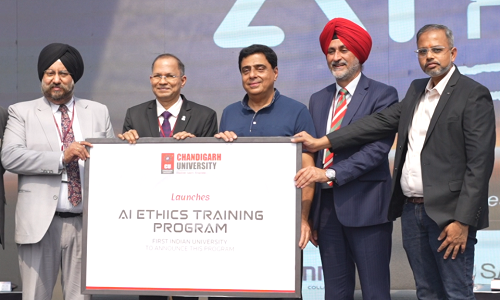 |
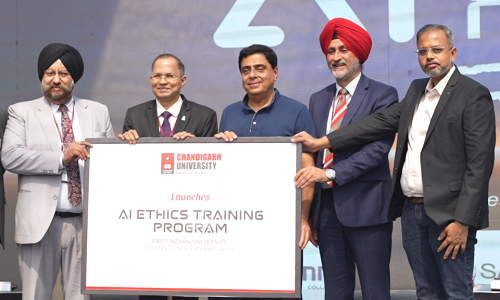
Ronnie Screwvala, Bollywood Producer & entrepreneur launching AI Ethics Program along with Chandigarh University Officials during AI Fest at Chandigarh University
Backed by expert mentorship and venture guidance, these startups will be empowered to transform breakthrough ideas into market-ready enterprises, contributing meaningfully to the Startup India mission and strengthening India’s entrepreneurial growth story. Apart from funding support, the high-impact startups will receive structured incubation, strategic handholding and access to strong ecosystem partnerships to help them refine their business models, accelerate product-market fit and scale sustainably.
Launched in August 2025, Campus Tank witnessed an overwhelming response with 21,789 registrations from 1,200 cities across India spanning seven key domains including AI & Deep Tech, Healthcare & Wellness, Climate & Sustainability, Business & Productivity, Education & Learning, D2C and allied sectors. Over 10,800 registrations came from universities and colleges, reflecting the scale of campus-driven innovation. While Punjab which is the host state recorded 359 startup registrations, Delhi contributed 1,256 startups with participation spread across multiple states nationwide.
The six-month selection process followed a rigorous funnel structure with over 21,789 registrations, 1,000 startups were shortlisted in round 1, followed by 500 in round 2 and 300 in round 3. Among these 300 semi-finalists, 100 market-ready startups were invited to exhibit their products (for pitching), while the remaining 200 continued in the ideation stage, presenting PPT-based pitches.
The evaluation of the Campus Tank Grand Finale was conducted through exhibition jury visits and venture capitalist pitching sessions and scoring by following a rigorous and highly competitive assessment process, the top 10 startups were announced on Saturday who got access to an investment pool of $6 million.
In his address on the conclusion of Campus Tank finale, Member of Parliament (Rajya Sabha) and Chancellor of Chandigarh University, Satnam Singh Sandhu said, “Campus Tank initiative is aimed at empowering the next generation of entrepreneurs in line with Startup India Mission which has become a revolution since its launch by the Prime Minister Narendra Modi in 2016. India has firmly established itself as the third-largest startup ecosystem in the world with over 2.16 lakh startups. Over 45% of recognized startups have at least one-woman director or partner. As compared to only four unicorns in 2014, the number has now risen to nearly 125 active unicorns. In 2025 alone, around 44,000 new startups were registered. Youth from Tier-2 and Tier-3 cities and even villages, are now launching startups to address grassroots challenges, reflecting a shift towards inclusive entrepreneurship. As instead of job seekers, India’s youth are now becoming job providers, over 21.9 lakh direct jobs have been created by start-ups in the last decade with smaller cities contributing over 51% of these startups.”
“Today, access to capital has been strengthened by the Union government through the Fund of Funds for Startups, which has supported investments worth over Rs 25,000 crore, along with schemes such as the Startup India Seed Fund and credit guarantee mechanisms to support entrepreneurs without collateral. Campus Tank is acting as a catalytic force for igniting the entrepreneurial spirit among young innovators in the country and help achieve the Union government’s ambitious target of transforming the nation into 2nd largest start-up ecosystem in the world by surpassing China and create 1,000 Unicorns by 2047,” Sandhu added.
Shlok Shrivastava, TechBurner Founder, Layers & Building Consumer Tech Brands said, “Whenever you come up with a new product, it’s natural for you face criticism. Anyone gets more criticism in the beginning stage because we are prone to more mistakes in our starting journey. It’s the same process for everyone. But we should not stop working if we receive criticism for our product. We should continue making and improving our products till the time criticism comes down. So it’s a process. You are not successful of your product is working in the market, success is that you have built a product. So we should just focus on making a product, its success or failure is not in our hand. You can’t build a brand in a day but your product creates your track record. If you deliver a good product to customers, your brand will get built over time.”
Nirmit Parikh, Founder & CEO, Bluemachines.ai and Group CEO – Apna, said, “Anyone building a new product or service needs to first get foothold in a particular area before going reaching out a bigger market and investors for the startup. First you need to find a customer who will use your product and then recommend it to someone else. This helps you get more customers and thus you can build good customer base in an area. Once you have captured the market in one area, then you can go with your customer network and business numbers to investors and pitch for funds to scale up the same model in other cities. This will help you get funding for your startup. But never scale up your business before making a winning product. And for testing your product, don’t go to your friends because they may not give you honest reviews, rather give your product to a person who is not biased to give review about your product. Be ready to face criticism but have trust in yourself that things will work out.”
Chandigarh University also launched India’s first AI Ethics Training Programme under its AI literacy initiative, reinforcing its commitment to responsible and inclusive AI adoption. Jai Inder Singh Sandhu, Managing Director, Chandigarh University said, “The launch of AI Ethics Training Program during the AI Fest at the Chandigarh University is a significant milestone for CU’s AI ecosystem. As artificial intelligence advances rapidly, ethics, governance and accountability must evolve alongside it, CU has taken this initiative as a step toward responsible Al leadership. As a part of the AI Fest, we today concluded InnovFest which proved a power-packed celebration of innovation, ideas and entrepreneurship. As Chandigarh University’s annual innovation and entrepreneurship festival, InnovFest not only showcased outstanding student talent, it also sparked creativity, promoted bold thinking and students have learned to turn their ideas of students into reality.”
Pulkit Mehrotra, Vice President, Unicorn India Ventures said, “AI adoption is no longer experimental — it is being actively deployed across enterprises. With that scale comes responsibility, and safety must be built in from day one. The biggest friction today lies in data privacy, compliance and legacy system integration. Startups must focus on solving one critical use case deeply rather than automating everything. Financial services and knowledge roles are already seeing strong penetration, and sovereign AI presents a real opportunity for India to build responsibly and lead globally.”
Neeraj Sharma, Senior Technology Manager of Nagarro Ltd said, “The only way to grow in technology is by building. Ideas matter only when they become working projects, tested prototypes and real solutions. Evaluators and investors look for execution and measurable impact, not just concepts. Platforms like the Smart India Hackathon and initiatives by the Ministry of Electronics and Information Technology offer strong support, but accountability is critical. In AI and data-driven products, rigorous validation on real data is essential before going live. Build responsibly and deliver real impact.”
Satyendra Kumar, Founder & CEO, ScoutEdge said, “The journey began by addressing gaps in traditional talent identification, where evaluation often lacked consistency and scientific benchmarks. Our vision is to make sports scouting transparent, data-driven and merit-based by integrating AI and advanced analytics. We aim to reduce bias, empower coaches with objective insights, and create equal opportunities for grassroots athletes by building technology that identifies and nurtures true sporting potential.”
Later, the names of the top 20 winners of the hackathon conducted under Chandigarh University’s Sandbox program were announced, with a total of Rs 6 lakh distributed as seed support, awarding Rs 50,000 to first-place winners, Rs 30,000 to second-place winners and Rs 10,000 to third-place winners to foster and accelerate deep-tech innovation.
In MedTech, Sambhav Kaushik Singh secured first place for Mediverse AI, Abhay Vishwakarma came second for Curalinks and Pawan Singh in third for Health-Tech. In Open Innovation, Sintu Kumar secured 1st place for Alpha, Kartik Guleria finished second for Relquik and Atishya Jain secured 3rd position. In Blockchain, Sandeep Yadav secured first place for AgriTrace, Sampooran Tripathi stood second for Civic Ledger and Akshat Kumar Tank finished third for Verifresh. In EdTech, Kali Rastogi secured first place for SkillSync, followed by Anish Gupta in second for DevHibs and Surya Pratap Singh in third for Assistive AI. In Robotics, Priyanshu Singh claimed first place for CropXprt, Shivam Upadhyay secured second for Security and Sachin Ruhela finished third for Edith. In the Agentic category, Abhijeet Maurya won first place for Axion, Anukalp Dwivedi secured second for FounderOS.ai and Raj Tiwari finished third for Taskpilot. In Smart City, Aakash Gaurav secured second place for City-Flex, while Shakti Sanjay MK finished third for Hydrax.
Meanwhile, Campus Tank Season 2 was also launched by Satnam Singh Sandhu, Chancellor of Chandigarh University and MP (Rajya Sabha), along with Nirmit Parikh, Group CEO of Apna and Shlok Shrivastava from TechBurner.
About Chandigarh University
Chandigarh University is a NAAC A+ Grade University and QS World Ranked University. This autonomous educational institution is approved by UGC and is located near Chandigarh in the state of Punjab. It is the youngest university in India and the only private university in Punjab to be honoured with A+ Grade by NAAC (National Assessment and Accreditation Council). CU offers more than 109 UG and PG programs in the field of engineering, management, pharmacy, law, architecture, journalism, animation, hotel management, commerce, and others. It has been awarded as The University with Best Placements by WCRC.
Website address: www.cuchd.in.