

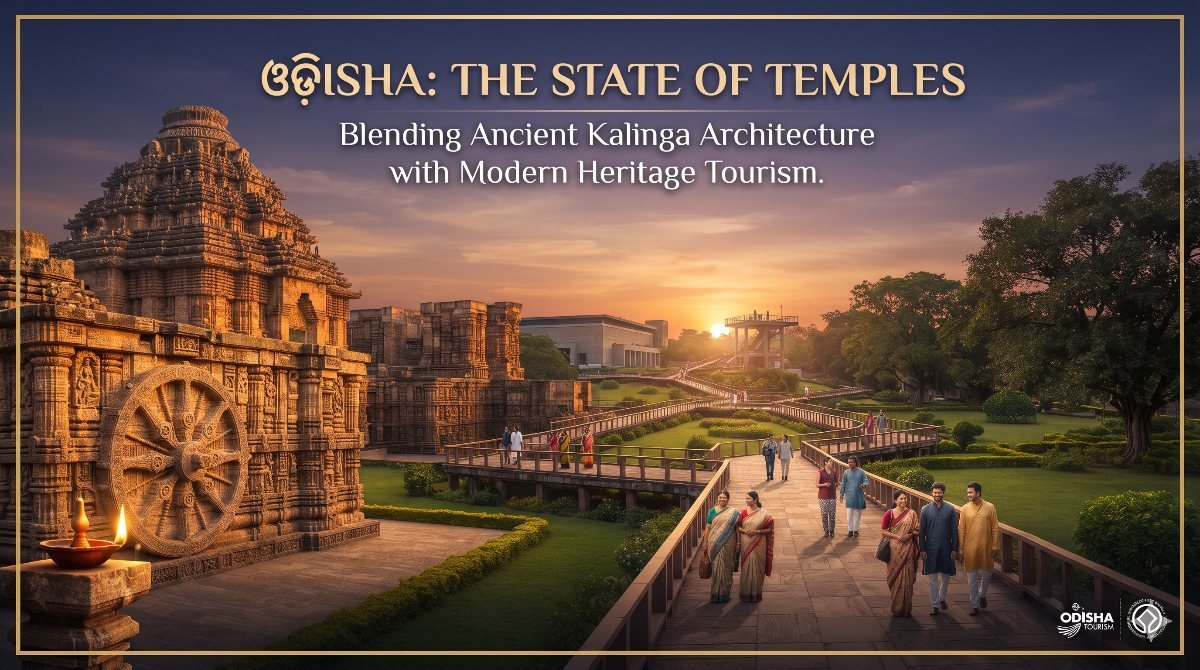



Odisha - The State of Temples
The Golden Triangle of Sacred Heritage
Visitors and pilgrims gravitate toward three flagship monuments that define coastal and central Odisha’s spiritual circuit:
Shree Jagannath Temple (Puri): A 12th-century shrine dedicated to Lord Jagannath, Lord Balabhadra, and Goddess Subhadra. Rising 65 meters high, the complex hosts the annual Rath Yatra chariot procession and serves traditional Mahaprasad inside Ananda Bazar.
Konark Sun Temple (Konark): Built around 1250 CE by King Narasimhadeva I, this UNESCO World Heritage Site is sculpted as a colossal stone chariot with 24 intricately carved wheels and seven horses aligned to catch the first rays of sunrise.
Lingaraj Temple (Bhubaneswar): The largest temple in Bhubaneswar, often called the "Temple City of India," this 11th-century landmark houses a self-manifested Shivalinga surrounded by roughly 150 smaller shrines.
Engineering the Kalinga Architectural Style
Unlike temple traditions in northern or southern India, Odisha’s monuments follow a distinct regional blueprint known as .
| Structural Component | Traditional Role | Architectural Signature |
| Rekha Deul | Main sanctum (Garbha Griha) | Soaring, curvilinear spire symbolizing spiritual ascent |
| Jagamohan | Assembly hall (Mandapa) | Square hall topped with a stepped, pyramidal roof |
| Nat Mandir | Festival and dance hall | Pillared or corbelled space for classical Odissi performances |
| Bhog Mandir | Offering hall | Dedicated chamber for preparing and presenting sacred food |
Art historians also highlight Bhubaneswar’s 10th-century Mukteshwar Temple—dubbed the "Gem of Odishan Architecture"—for its free-standing arched gateway (torana) and stone lattice windows depicting Panchatantra fables.
Beyond Hindu Shrines: A Multi-Faith Landscape
Odisha’s spiritual landscape extends well beyond Shaivite and Vaishnavite traditions:
Jain Rock-Cut Heritage: The twin hills of Udayagiri and Khandagiri near Bhubaneswar preserve early rock-cut caves and royal inscriptions tied to ancient Jain ascetic communities.
The Buddhist Diamond Triangle: The monastic complexes of Ratnagiri, Lalitgiri, and Udayagiri once functioned as major centers of Mahayana and Vajrayana Buddhist scholarship across Asia.
Living Craft Ecosystems: Nearby heritage villages such as Raghurajpur sustain temple-linked arts—including Pattachitra scroll painting, palm-leaf engraving, and stone carving—connecting ancient iconography to modern livelihoods.